Philip French

The artist who intrigues and surprises
Artist profile of Philip French by Lynda Cookson
Published in December / January 2005


Meeting Philip French was like peeping out from beneath my fingers at an unexpected view. Each time I looked, I saw something I didn’t expect to see. Intrigued, I carried on peeping.

I was looking forward to meeting the man who owned the lovely deep voice on the telephone, but was quite unprepared for the dapper suit and cravat clad gentleman, with ruler-straight hair almost to his shoulders, who opened the gallery door. ‘Oh, here we go’ I thought. ‘Lots of show and not too much substance’. Ouch! Did I have to retract my catty thought, or what! Philip is a delight to get to know. He is an enigma to surprise and entertain you, with tales and perceptions to keep an audience enthralled.


He had kindly agreed to step in and be interviewed in place of his wife, Kate, a sculptor. Kate had seriously hurt her back that morning and I could hear on the telephone that she was not well enough to meet with me. Luckily Philip was free, and happy to stand in.

In no time at all I was ensconced on a comfortable couch at the back of Gallery 23 in Kinsale, with a hot cup of tea steaming in my hands and Philip happily telling me about his life and art. To say he exudes a love of life doesn’t quite fit the bill. It’s rather a deep appreciation of the value of life, a fascination with those values, and the pleasure he has found in his travels, that I heard from him. He talks a lot, he talks fast, and he doesn’t waste a word!

Time to rest my eyes and then take another peep.


After attending the Hornsey Art College, Philip studied for his BA (Hons) in Fine Art at the University of Central England in Birmingham. He was then invited to join the Royal College of Art to take his M.A. (RCA), but as he had spent too many years in an institutional environment, they suggested he take a year off before beginning. He was 21 years old at the time, so was more than happy to pack his bags and travel.

The first six months saw him working in Australia, earning enough so that he could tour the Far East for the remainder of the year. While in Australia, he was lucky enough to be able to visit the Aborigines-only Palm Island, off the Great Barrier Reef. No White people were allowed on the island unless they were involved in running the utility services. Philip relates one of his experiences during the one-hour bar opening time on the island :
‘Everyone is living on the dole, and because the pub is only open for one hour, they all rush in and get immediately pissed. There was an old woman sitting next to me, giving me her whole life story, including how her husband beats her up, and leading up to her asking me for a sip of my drink. I took one look at her inflamed and diseased mouth, and gave her the whole drink! Not long after that, there was sudden chaos with everyone joining in a big fight.’ An eventful day in the life of a one-hour pub.


Philip spent a fair amount of time touring Bali in Indonesia, and that country still has an influence on the colours he uses in his art. While there, he hired a motorbike to take him up into the hills. Twenty years ago, the locals were still relatively unused to tourists, and cheerily waved to him as he sputtered by. Philip waved back each time, but wondered why the villagers reacted in a horrified manner, ducking, and shielding their faces with their arms. He continued along in his breezy manner, absorbing the thrill of the temples, the reds, blues and greens of the people’s clothing, the rice paddies and the amazing sculptures everywhere. That evening, he mentioned the odd reaction people had to his wave, to a fellow traveller. The traveller asked: ‘Which hand are you waving with?’ Philip replied: ‘Well, seeing as my right hand is occupied with the throttle of the motorbike, I suppose I’m waving with my left hand.’ A prime case of West meeting East this time. The young Philip had no idea that to greet or to do anything at all with your left hand is the biggest insult in the Muslim culture. Indonesia is almost entirely Muslim.


Colour is big in Philip’s painting. Not necessarily big in contrast or purity, but big in lightness, brightness and catching the light. He knows how to use colour so that the viewer is almost not aware of the number of different colours he has used, or how skilfully he has used them to emphasise a light source or shadow. He works mainly plein air (on site outside) and uses watercolour on Fabriano Italian paper, or in his studio with oil on linen canvas which he has stretched himself. Philip considers his work to be traditionalist with an eastern influence in his choice of colour.

In the early days of his career, when his first-born, a daughter named Lucy arrived, he and Kate were living in London. After Lucy’s birth, Philip found he could not paint. He was so in awe of his child, the ultimate creation, that he felt he could not match it! He took to walking the streets of London for inspiration and began to see the great city from a different perspective. He went home to Kate and said: ‘Let’s get out of here.’ That is how, twenty years ago and two sons later, together with Kate’s parents, the family of five arrived in Kinsale as blow-ins.

From producing huge abstracts since his college days, Philip found himself living in a much smaller environment and having to reconsider the size, scope and subject of his paintings. He took to getting in the car with his painting gear, turning the key and letting the car find the painting. Often, he has been caught in the rain, and while dashing for the car, the raindrops land on his painting. He leaves them there and waits to see what happens. By the time he gets home, there is usually a beautiful, natural rain-drop effect to his painting!


Like the painter Turner, Philip has a studio upstairs from the gallery. He has more studio space at home, but likes to be near the gallery where he has the chance to meet some of the people who buy his art and take it away. For him, it’s a final touch of satisfaction to see the collector’s response to his work.

Philip has represented Ireland on a number of occasions, exhibiting widely, and with his paintings featuring in a number of prestigious collections in Ireland, Italy, Japan, Belgium and England. He has worked with galleries in Canada, London, Brussels, New York and Ireland. Right now you can see his paintings at Gallery 23, Chairmans Lane, Kinsale or by visiting www.artistfrench.com
.


~~~~~~~~~~~~~~~~~~~~~~~~~~~~~~~~~~~~~


Susanne Leutenegger

" ..... but that's not the beginning"
Artist profile of Susanne Leutenegger by Lynda Cookson
Published in June 2006


Space is very important to Susanne Leutenegger, a full time member of the Backwater Artists' Group in Cork, Ireland. In taking space away she creates more. We picked our way across her varnished wooden studio floor, gingerly stepping in the small spaces left between paintings and pots of paint ruling supreme where feet usually dominate. No chairs. No stools. Suzanne sits or kneels on the floor to work. She kindly sourced a stool from somewhere for me and I perched there, an obvious intruder disrupting the flow of paintings as they spread from the floor up all the walls, with abstract cardboard sculptures and cut-outs filling the sunny space on the window ledges. And yet by filling this space with her work Susanne, in her own words, is creating yet more space: "Painting for me is giving space. Giving space to what is yet silent, what is waiting patiently, what is undiscovered. I usually start with a blurred, unknowing surface and a searching line, letting them explore a movement together. I like the idea that they carry an essence of being."

"Lightning" by Susanne Leutenegger

Early days
She was born in Sankt Gallen in Switzerland in 1957 but only began her art studies when she came to live in Ireland in 1983. Four years later she graduated with a distinction in Fine Art from the College of Art and Design in Cork but was disappointed at the lack of visual art facilities in the area. In those days there was only one gallery in Cork - the Lavitte Gallery, and most of the art graduates left Ireland to chase their dreams on more fertile ground in Europe or the States. Not long after her graduation, her German husband's work took them back to Oldenburg in North Germany, where they stayed for the next seven years.

"Trumpet Flower" by Susanne Leutenegger

Boom times in Germany
Susanne remembered that: "Those were boom times in Germany. Everyone wanted to buy art, so I could make a modest living. What struck me most was how many people knew about art and were open to abstract art. In Ireland people were scared of abstract art. However, we missed Ireland. It is special here and in 1994 my husband found a permanent job here in Cork, so we returned. It was great to reconnect with other artists and friends."

When she first arrived in Germany she was gripped by a fear that she was never going to paint again and her paintings shrank in size, becoming tight and overly constructed with her nervous movements. She felt under pressure to prove herself. Finally she met other artists and they founded a collective in an old factory. Their ideas were big, their meetings constant and their theory bursting to become reality. Installation art was not huge in the late 1980s but that was largely what came out of this energy and the freedom they gave themselves.

Susanne returned to a changing Ireland. The Celtic Tiger had arrived. No longer were she and her husband the exotic foreigners they had been in the early 1980s. They settled in Crosshaven, enjoying being part of a small community and Susanne started painting again. But this time there was a special quality - she had become a mother and her work was softened and influenced by her need to nurture another type of creation. She says: "It brought another human dimension into my art."

"Schnapp" by Susanne Leutenegger

Mixing paints and chalks
Colour, and not just the choice of colour but the quality of colour, is paramount for Susanne. She finds commercial acrylics too shiny so she mixes her own paints using concentrated pigments, oxides, marble dust, and quartz dust, bound with an acrylic medium and used straight from the little glass jars she mixed them in. Also part of her tool kit are oil bars, oil of cloves as a preservative, and chalks - which she makes herself as well. Susanne looked up from where she was crouching amongst her precious pots, brandishing a fat piece of chalk. "Commercial chalk colours are limited so I mix refined Plaster of Paris with pigments like oxide and then mould them. To use them I dip them into a solution of water and acrylic medium so that when it is dry is it fixed."

 "Horizontal Underground Stem" by Susanne Leutenegger

Shape, line and words
She starts with a line on paper but that's not the beginning. Alone in her studio Susanne moulds three-dimensional shapes with clay, letting her thoughts slip away and allowing her mind to draw on its subconscious. She moves on to producing loads and loads of small sketches, not wanting them to be art pieces on their own but rather to be fragments to inspire a part of the final creation. She doesn't expect to feel much about them on that day but opens the studio door the next morning with a sense of anticipation at what she might feel when she looks at them with fresh eyes. Her eyes widen at the thought of being able to say: "Wow" I can use this!"

The title of an art piece becomes part of the whole creation. She reads a lot and takes notes of quirky words, titles, and snippets that will give her the feeling for a made up word in the tradition of the Dada people, or for a title to give a painting that final burst of life. There's a sense that her work is complete within the triangle of shape, line and words. In her own expression of what she does, her energy is tangible as she begins, then becomes balanced as the creation blossoms into being and runs out, her words becoming one as the energy is spent:

Trustful I enter into a dialogue with new existences.
Hands become leaves,
leaves become feathers,
feathers become feet,
feet become flower buds,
buds become paddles,
paddles become bells,
a bell a wing,
a wing a rattling gourd,
a gourd pearl,
pearl stonefruitkernel.

 "Misia" by Susanne Leutenegger

What does Susanne want people to feel about her art? "I've never thought about that! I paint for myself. And I don't want to analyse my work too much - I don't want to lose the intuitive side."

In June 2005 she co-founded the artists' co-operative gallery Arthaven in Crosshaven. It's a large bright space on the waterfront in the centre of the town, where the work of the co-operative members as well as other artists is exhibited and sold.

Susanne's work is permanently represented by Galerie Kunstueck in Oldenburg, Germany; Galerie Flora in Wil, Switzerland; Galerie Artforum in Hanover, Germany; and the O'Sullivan Bewick Gallery in Enniskerry. Her paintings are part of public and private collections in Germany, Switzerland and Ireland (University College Cork and Quest).

"Velvet Blossom" by Susanne Leutenegger

www.SusanneLeutenegger.com

Later, I received this lovely note from Susanne:

Dear Lynda, how exciting to get suddenly an article written about me in the
post ! I was a bit nervous about reading it first, and after the first
paragraph settled and enjoyed the words that you found and the short but
precise style. What amazes me most was that you remembered the details and
the whole story together so well after half a year and that you really seem
to have listened and heard what I was about ! Wow ! Thank you very much !
Obviously you are an artist yourself and you know what process in mind and
on canvas you are talking about.
Many thanks Susanne
Tue, 2 May 2006

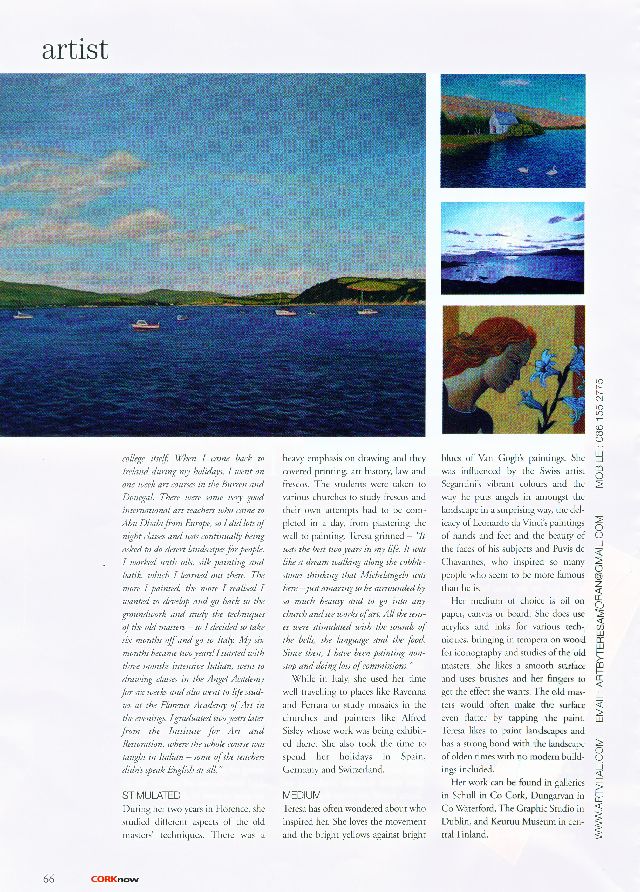
Teresa Moran

Walking the cobblestones of Florence

Artist profile of Teresa Moran by Lynda Cookson
Published in "Cork Now" September 2006


There's a house high up on a mountain on the Sheep's Head Peninsula overlooking the breathtaking views of Bantry Bay in County Cork, and it's full of peaceful paintings by the live-wire who is Teresa Moran. The sun was high when we began photographing her work and by the time hunger took over and a light supper was laid on the table, the scarlet sun was sinking behind the hills across the bay and I was dizzy with the details of her life of travel and art.


Teresa cannot remember a time when she didn't paint or draw, using watercolour and crayons as children usually do. She took extra classes on Saturdays with a talented nun and even won a competition "... something to do with peace" she vaguely recalls. "I would have liked to go to art college but career guidance was sadly lacking when I left school and I only heard talk about being an air hostess or a secretary. I took myself off for a year and au paired for a family in Paris. I was only sixteen going on seventeen at the time. France was good to me. I took an intensive course in French at the Sorbonne. The course also covered culture, political law, geography and art, and every week we would go to the Louvre, or somewhere else, and study a particular artist, then go on to the museum. It was an absolute joy for me and I loved the exhibitions. The family were lovely too. They took me skiing and to a chateau just outside Paris where I spent hours drawing in the grounds."


When she returned to Ireland she signed up for European Studies at NIHE (which is now known as the University of Limerick). She wanted to study languages but in the first year they were taught business subjects which included marketing. Teresa found she loved the logic and fun of marketing. She switched courses and graduated after four years of study, coming first in her year. During her degree years, at the age of nineteen, she spent eight months in Germany with the German Academic Exchange Service who also give grants to artists, musicians and writers, so again she was exposed to art and artists. She also took a year off to go and live and work in Sydney in Australia, staying with friends of her mother's and working in a small electrical company. She says: "It was a fun job and I came back with savings!"


After qualifying she worked in England for two and a half years before taking a one year teacher training course in London and attending life drawing classes at the same time. She returned to Ireland and taught marketing in Dundalk for three yars, doing oil paintings in her spare time. And then she was off again!

"My sister went to work in Abu Dhabi in the Middle East so I went too and taught marketing there for five years. After that I spent seven years marketing the college itself. When I came back to Ireland during my holidays I went on one-week art courses in the Burren and Donegal.

There were some very good international art teachers who came to Abu Dhabi from Europe so I did lots of night classes and was continually being asked to do desert landscapes for people. I worked with oils, silk painting and batik, which I learned out there.


The more I painted the more I realised I wanted to develop and go back to the groundwork, studying the techniques of the old masters. I decided to take six months off and go to Italy. My six months became two years! I started with three months intensive Italian, went to drawing classes in the Angel Academy for six weeks and also went to life studies at the Florence Academy of Art in the evenings. I graduated two years later from the Institute for Art and Restoration, where the whole course was taught in Italian. Some of the teachers didn't speak English at all."


During her two years in Florence she studied different aspects of the old masters' techniques. There was a heavy emphasis on drawing, and they covered printing, art history, law and frescos. The students were taken to various churches to study frescos and their own attempts had to be completed in a day, from plastering the wall to painting, Teresa grinned - "It was the best two years in my life. It was like a dream walking along the cobblestones thinking that Michelangelo was here ... just amazing to be surrounded by so much beauty and to go into any church and see works of art. All the senses were stimulated with the sounds of the bells, the language and the food. Since then I have been painting non-stop and doing lots of commissions."

While in Italy she used her time well, traveling to places like Ravenna and Ferrara to study mosaics in the churches, and painters like Alfred Sisley whose work was being exhibited there. She also took the time to spend her holidays in Spain, Germany and Switzerland.


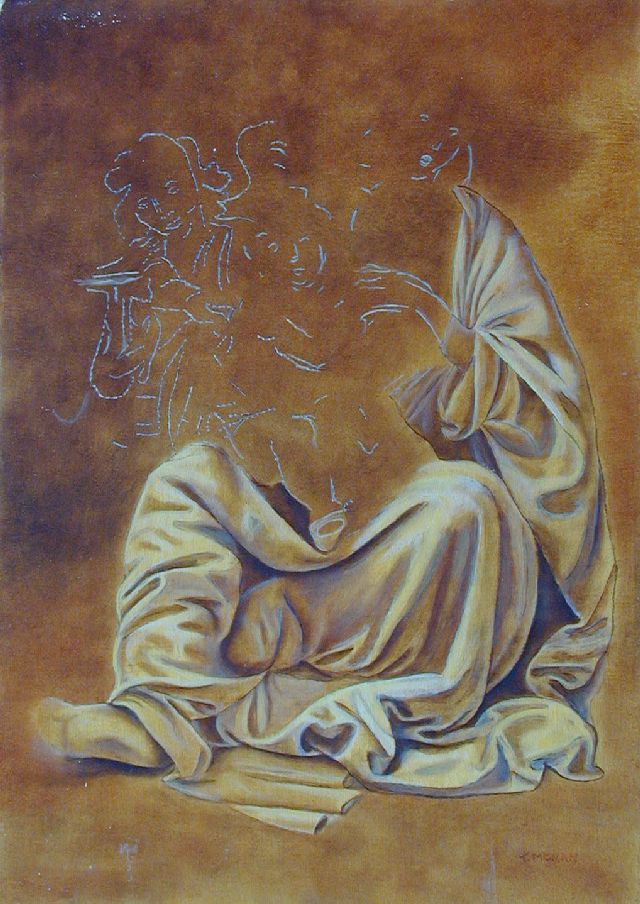
Teresa has often wondered about who inspired her. She loves the movement and the bright yellows against bright blues of van Gogh's paintings; she was influenced by the Swiss artist Segantini's vibrant colours and the way he puts angels in amongst the landscape in a surprising way; the delicacy of Leonardo da Vinci's paintings of hands and feet and the beauty of the faces of his subjects; and Puvis de Chavannes who inspired so many people who seem to be more famous than he is.

Her medium of choice is oil on paper, canvas or board although she does use acrylics and inks for various techniques, bringing in tempera on wood for iconography and studies of the old masters. She likes a smooth surface and uses brushes and her fingers to get the effect she wants. The old masters would often make the surface even flatter by tapping the paint. Teresa likes to paint landscapes and has a strong bond with the landscape of olden times with no modern buildings included.

Her work can be found in galleries in Schull in Couty Cork, Cungarvan in County Waterford, The Graphic Studio in Dublin, and Keuruu Musem in central Finland.

http://www.artbyteresamoran.com/
http://www.halosandwings.com/


Jenny O'Brien

"Patience" by Jenny O'Brien

I first met Jenny O'Brien in the Spanish Arch Hotel in Galway one morning, and interviewed her across a white-linen-clad table in the empty restaurant. My son was restaurant manager at the time, and as I couldn't drive after having cut my hand very severely on glass, he kindly gave us permission to conduct our interview over idle silver cutlery and sad-looking wine glasses, awaiting their table napkin adornments. Noisy chefs in the adjoining kitchen were our background music as curious staff members thudded up and down the wooden staircase between downstairs bar and first-floor restaurant.

"Marilyn" by Jenny O'Brien

I was again reminded of Jenny a couple of months after our interview, when I heard her pure voice singing on Galway Bay FM radio. I remembered she played in a wedding band, that music was a huge thing in her life .... and was proud indeed, possessive of the knowledge that 'I knew her', when I heard her sing. Our interview had covered most aspects of her portraiture and painting career but had only touched on her music career.

I wanted to spotlight Jenny here because recently she has shown a lot of kindness and generosity to my niece, Ferne Krystal, who is an aspiring singer and lyricist. She met with us in Athenry (Co. Galway, Ireland) one lunch time and was quite happy for Ferne to pick her brains about all things musical in Ireland, giving her sound advice about recording equipment and offering to work with her on a dem CD.

"The Wedding Couple" by Jenny O'Brien

A few weeks later, after my husband's work Christmas dinner - in February! - we ambled down to the Quays bar in Galway's night hot-spot, to hear Jenny sing with a Funky Rock band, which she does from midnight every Thursday. We arrived early, all the better to pick our good viewing seats in the pub, and Jenny immediately came over to us to chat and give Ferne more advice and titbits, before taking her place on the stage with the band. And wow! what a natural, easy and well-projected voice our Jenny has! We loved the music and loved her singing.

Ferne called Jenny a week or so later and arranged to get together to record a couple of songs, which they duly did, in the recording studio in Jenny's home. She generously gave hours of her time, her skills and the use of her equipment, in her usual friendly and open way.

Thank you Jenny! It's my pleasure to once again highlight your self and your talent.

This is Jenny's profile:

Jenny O'Brien
"I'm not particularly full of angst and just want to express myself"

Jenny O'Brien's mother is an artist and used to keep the cereal boxes for her children to draw on. "There was always loads of arty stuff around the house ... and I thought everybody's house was like that. I remember when I was almost five years old I wrote on the wall and tried to blame it on my then-unborn brother!" Her dad was a guitar and trombone player so Jenny was always encouraged to either draw or play music - her instrument being the piano. when she got to secondary school she had to choose between music and art. Art won and she continued with piano lessons but didn't go down the academic route with music.

"Buttons" by Jenny O'Brien

She was born in the Coombe Hospital in Dublin in 1976 and when she was three the family moved to Cork, from there to Wexford and in 1995 Jenny moved to Galway. She had been doing a teaching degree in Dublin for two years, but felt that there was no focus on the actual learning of her discipline. She knew she wanted first and foremost to be a painter and felt too young to teach. "Even now I get asked for ID!" she grinned. "You have to learn what it is you're teaching before you can teach."

She transferred to Galway to do a Fine Arts Higher Diploma. "Neither my Leaving Cert nor my studies in Dublin stirred any philosophy for me and I felt that that part of my brain was starting to atrophy with lack of use. I had forgotten how to form an opinion on a piece of work and felt too far removed from where I wanted to be. I needed to change that." To cut a long story short, she got engaged to Kieran Kelly who teaches guitar and writes music and lyrics; plays and sings in a wedding band called "Fraggle Rock" (who have recently released a CD); and moved to Athenry where she and Kieran have built a house.

Jenny's degree exhibition centred around portraits. Exposure to variety in the arts whilst doing her degree in Galway gave her a focus and she found portraits to be her natural inclination. "I've developed my style over the years and can recognise now when a painting is working and when it's not. My standards are higher, still a bit refined, but less brown and dark ... I've come out of my gothic style now!"

"The Boys" by Jenny O'Brien

"I paint murals as well and have wonderful conversations with children while I'm painting their walls. One little girl of eight or nine years old wanted a forest scene and I found it quite daunting trying to keep up with her imagination."

Jenny works with oils on canvas but for smaller paintings she uses little pieces of board, and because it needs to be more precise she uses brushes only. For portraits she uses very fine brushes actually meant for acrylics, working from good photographs - which she prefers to take herself. "I want to get a likeness and the character of the person."

"Matteo" by Jenny O'Brien

"My techniques are pretty traditional. I work up layers of paint with glazing - it takes a while and I need to look back at it. I don't exactly reproduce the photograph but if it works, a painting can be a stronger image because it's what you see in someone as well as what their face looks like. When you do a portrait there is something of yourself in it too.

"Edward Hopper would be a good influence on me. At college one student spoke about how beautiful his work was and my viewpoint was completely to do with the people and how miserable they looked in some of his work during the depression in the States. When I started college in Galway I felt back in a creative atmosphere, finding out where I fitted in. I'm not particularly full of angst or anything and just want to express myself and my interest in people and people-watching. I'm curious, just nosy really, about their behaviour and the reasoning for them being the way that they are.

"The Central Hotel" by Jenny O'Brien

"I find 'that moment' fascinating and I like to catch people unawares. I'd like to be doing more work that lands closer to observation of people but not necessarily portraits. Putting people into a setting and painting what I see as well as including things I think are amusing, are my inspiration."

Jenny's work to date has been mainly commission based but recently she has begun working on paintings with a view to a solo exhibition. Her 2006 exhibition and calendar launch in the Kenny Gallery in Galway gave her a tremendous boost and she's working to aim higher this time.

www.jennyobrienportraits.com


Tea at The Hobb in Middle Wales


Beginning at the end, above is the painting which twelve artists, who were Taking Tea at The HoBB in Knighton, Middle Wales, 11 May 2010, created. It's called "Welsh Web" and it's acrylic on linen-covered board.


The HoBB


Elf, creator incredible, writer, and epitomy of the essence of life a.k.a. Grant, who keeps The HoBB vibrating with magic, together with his wife Helen, burst a bubble of enthusiasm over me .... the rainbows of which lead to a tasty and painterly few hours of fun, chat and acrylics with these artists:

Jilly Tinniswood, Anne Collins, Martin Herbert, Vivi-Marie, Ciara Lewis, Julia Harris, Bronte Woodruff, Grant, Helen, Brenda Mackay, Mavis Chapman and myself.


Grant, Mavis Chapman, Helen
(backview of Anne Collins, Ciara Lewis)


Mavis Chapman, Helen, Vivi-Marie, Martin Herbert
(backview of Anne Collins, Ciara Lewis)


Brenda Mackay, Ciara Lewis, Anne Collins, Grant
(backview of Mavis Chapman)


Mavis Chapman (centre front) Helen (backview)
Vivi-Marie, Martin Herbert, Jilly Tinniswood

I'd been searching for a reason to visit The HoBB for two or three years, after chatting with Grant on the Ecademy.com networking site - and being entranced by his messages, feeling his enthusiasm for everything which comes his way. Then last month, May 2010, I had to fetch my Mum (Mavis Chapman) and eldest sister (Brenda Mackay) from London where they had been staying with my middle sister. Ha! None of us had visited Middle Wales and Brenda, herself an artist and over from South Africa to visit my Mum, is always up for a bit of extra travel .... so we were on! An email to Grant and within hours Roisin, my PA, was searching google for artists to invite.

Even just inviting artists was fun .... I linked up with a handful of artists who couldn't make it on the day but who I hope to keep in touch with and visit next time.

Before boarding the Irish Ferries "Ulyssess", I stocked up with some deliciously sugary and chocolatey goodies, boxes of different teas and coffee ... and felt not a hint of diet-police guilt. We were, after all, going to be Taking Tea.

What I hadn't mentioned in my emails to the artists was that I also planned for us to be painting a joint painting. A huge bag stuffed with acrylics, brushes, palette knives and clothes sat heavily next to a linen-covered board - primed for painting - and a travel easel in the boot of my car.

The next thirty-six hours of driving - Maam Valley in the West of Ireland to Dublin, across the puddle to Holyhead, on to Stevenage and back to the village of Presteigne in Middle Wales - was lightened with pleasant anticipation. Finally, my hands tender from manipulating a steering wheel for so many hours, we plonked our luggage down in a garden lodge of the Radnorshire Arms Inn in Presteigne ... all three of us secretly hoping for ghosts, after having read the bloody and secretive history of the Inn building. (You can find it here www.radnorshirearmshotel.com/history.html - it's an excellent read!) I definitely heard a creaking and a cranking in the walls, but as that part of the hotel was only built in the 1970s I fear it was simply the plumbing.

Next morning, bright and early, we were in the car, skidding to a halt here and there to dash out and take photographs like all good tourists ought to do, on our way to The HoBB. We missed our turning into the driveway, but it was almost on purpose as we were so enjoying the scenery, the bunnies scampering into the hedgerows, and the cockerels strutting their stuff in farmyards, so much that we almost didn't want to arrive too soon. But arrive we did, into the welcoming embraces of Grant and Helen - and straight into their kitchen to prepare the goodies.

Grant lead me outside, past miniature wooden elves houses lined up on a shelf in a wooden shed area which only belongs in a twinkling book of fantasy - to a room which he and Helen have built ... into it's environment. I think that's the best way to describe it. It's wooden, with the most incredible carved door, lovingly created by Grant; it looks down the field of sheep in front of it through glass windows angled out to make the most of the view and has dragon scales and a forest of trees embossed in cement on its walls.


He thought it might be the ideal place for us to create our painting. He was right. It was brilliant.

We warmed up and got to know one another around the table set for tea; then took our chatter out to The Dragon Scale Room where the talk never stopped and the brushes just flew over the canvas.


This is how "Welsh Web" began ......


... progressed a little more ...


... and so it carried on ...


... until this point, just before it got a few more splashes
before it's journey home to become this ...


The final "Welsh Web"

I took a video of the whole painting process ..... just a little editing and it'll be here to enjoy.

Anyone want to Take Tea with Artists? Give me a shout!