Thursday, February 19, 2009

Jenny O'Brien

I first met Jenny O'Brien in the Spanish Arch Hotel in Galway one morning, and interviewed her across a white-linen-clad table in the empty restaurant. My son was restaurant manager at the time, and as I couldn't drive after having cut my hand very severely on glass, he kindly gave us permission to conduct our interview over idle silver cutlery and sad-looking wine glasses, awaiting their table napkin adornments. Noisy chefs in the adjoining kitchen were our background music as curious staff members thudded up and down the wooden staircase between downstairs bar and first-floor restuarant.

I was again reminded of Jenny a couple of months after our interview, when I heard her pure voice singing on Galway Bay FM radio. I remembered she played in a wedding band, that music was a huge thing in her life .... and was proud indeed, possessive of the knowledge that 'I knew her', when I heard her sing. Our interview had covered most aspects of her portraiture and painting career but had only touched on her music career.

I wanted to spotlight Jenny here because recently she has shown a lot of kindness and generosity to my niece, Ferne Krystal, who is an aspiring singer and lyricist. She met with us in Athenry (Co. Galway, Ireland) one lunch time and was quite happy for Ferne to pick her brains about all things musical in Ireland, giving her sound advice about recording equipment and offering to work with her on a dem CD.

A few weeks later, after my husband's work Christmas dinner - in February!! - we ambled down to the Quays bar in Galway's night hot-spot, to hear Jenny sing with a Funky Rock band, which she does from midnight every Thursday. We arrived early, all the better to pick our good viewing seats in the pub, and Jenny immediately came over to us to chat and give Ferne more advice and titbits, before taking her place on the stage with the band. And wow! what a natural, easy and well-projected voice our Jenny has! We loved the music and loved her singing.

Ferne called Jenny a week or so later and arranged to get together to record a couple of songs, which they duly did, in the recording studio in Jenny's home. She generously gave hours of her time, her skills and the use of her equipment, in her usual friendly and open way.

Thank you Jenny! It's my pleasure to once again highlight your self and your talent.

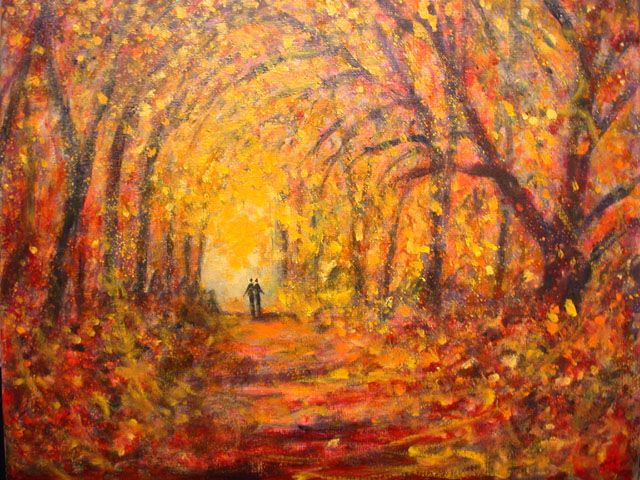
Click on 'Buttons' below (one of Jenny's portrait paintings) and he'll take you through to Jenny's website.

Sunday, February 1, 2009

Tea 'n Turps

I probably won't be uploading any more excerpts from my artist profiles. I've decided that there's a good sample of them here already, and I'm rather putting the time into writing fresh material.

I did an exciting thing for me yesterday .... I sent in my completed manuscript entitled "Tea 'n Turps" for final editing. In a month or so it will be out there looking for a publisher.

"Tea 'n Turps" (I hope the book can keep that title) presents the profiles of twelve artists together with a bit more info from me, and images of the artists' work.

More later .....

Lynda

Please check out my Amazon Book Shops here : (just click on "Amazon Goodies")

Friday, November 7, 2008

More to come ....

I have many more artist profile articles to scan and upload .... just lacking the time .... but I'll whittle away at it so please keep checking back!

Monday, August 4, 2008

Walking the cobblestones of Florence


TERESA MORAN

Walking the cobblestones of Florence

By Lynda Cookson

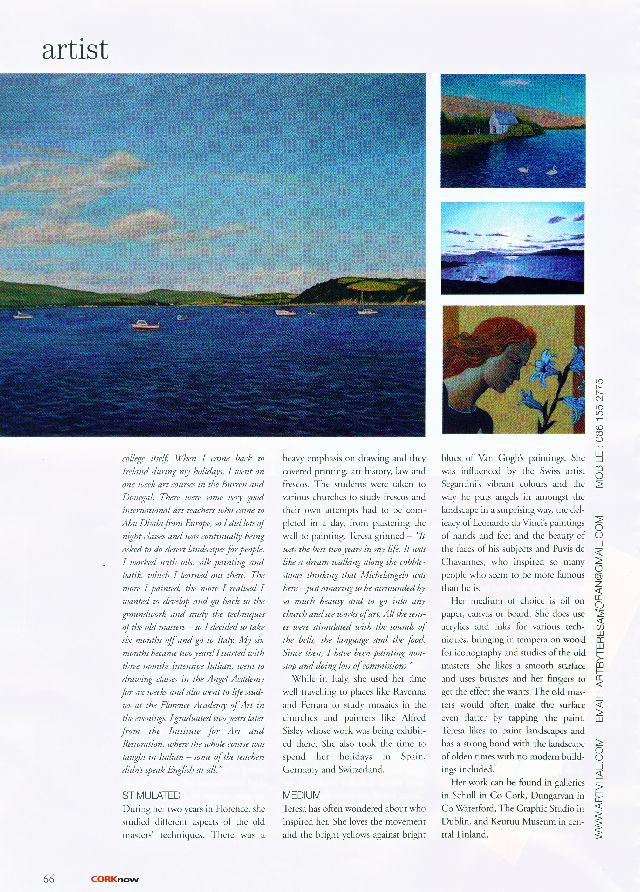
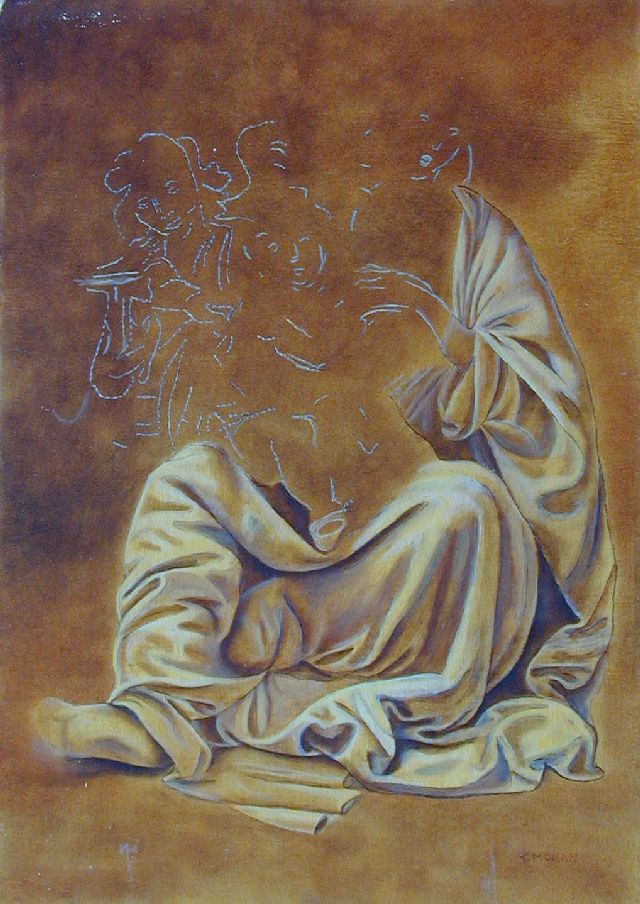
There’s a house high up on a mountain on the Sheep’s Head Peninsula overlooking the breathtaking views of Bantry Bay and it’s full of peaceful paintings by the livewire who is Teresa Moran. The sun was high when we began photographing her work and by the time hunger took over and a light supper was laid on the table, the scarlet sun was sinking behind the hills across the bay and I was dizzy with the details of her life of travel and art.

‘….. but that’s not the beginning’


SUSANNE LEUTENEGGER

‘….. but that’s not the beginning’

By Lynda Cookson

Space is very important to Susanne Leutenegger, a full time member of the Backwater Artists’ group in Cork. In taking space away she creates more. We picked our way across her varnished wooden studio floor, gingerly stepping in the small spaces left between paintings and pots of paint ruling supreme where feet usually dominate. No chairs. No stools. Suzanne sits or kneels on the floor to work. She kindly sourced a stool from somewhere for me and I perched there, an obvious intruder disrupting the flow of paintings as they spread from the floor up all the walls, with abstract cardboard sculptures and cut-outs filling the sunny space on the window ledges. And yet by filling this space with her work Susanne, in her own words, is creating yet more space: ‘Painting for me is giving space. Giving space to what is yet silent, what is waiting patiently, what is undiscovered. I usually start with a blurred, unknowing surface and a searching line, letting them explore a movement together. I like the idea that they carry an essence of being.’


Philip French

The artist who intrigues and surprises

By Lynda Cookson

Meeting Philip French was like peeping out from beneath my fingers at an unexpected view. Each time I looked, I saw something I didn’t expect to see. Intrigued, I carried on peeping.

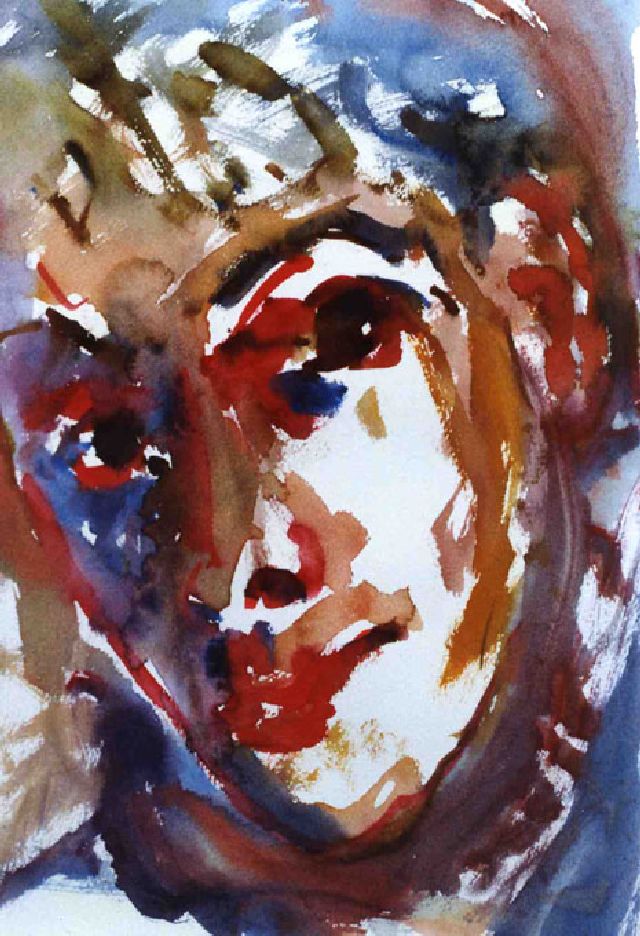
I was looking forward to meeting the man who owned the lovely deep voice on the telephone, but was quite unprepared for the dapper suit and cravat clad gentleman, with ruler-straight hair almost to his shoulders, who opened the gallery door. ‘Oh, here we go’ I thought. ‘Lots of show and not too much substance’. Ouch! Did I have to retract my catty thought, or what! Philip is a delight to get to know. He is an enigma to surprise and entertain you, with tales and perceptions to keep an audience enthralled.
Déjà vu in Paris


MONICA BOYLE

Déjà vu in Paris

By Lynda Cookson

As the ferry slipped into the harbour on Eigg Island in the Hebrides where Monica Boyle was working at the time, she mused on the feeling of knowing the intimacies of the islanders’ lives as well as knowing the ways of mainland folk. She felt like both an insider and an outsider and yet neither one, in a limbo between the two - and so, in the late ‘80s her fascination and love affair with islands began. In her own words: ‘I have never been able to understand or escape my growing infatuation with 'the islands'. It has compelled me for decades to fall through layers of relationship from distant admirer, acquaintance and finally lover to a whole archipelago. Like most obsessions, it has become narrower in its focus, mainly the islands around West Cork and Heir in particular. The first time I went to Paris, the hamlet of houses on the west coast of Heir island, it all seemed very familiar to me, I had a sense of déjà vu and felt as if I had been there before. Sole possession or an understanding of the relationship is not a necessity for me. It is my 'encounter' with the offshore islands and my subsequent response to it in paint that is important to me. Water, land and sky merge and separate into abstracted forms as I wipe paint on and scrape it off again. I dip my finger in vibrant vermillion and make an emphatic smear, which is then enveloped in a haze as I smudge grey-blues around their edge. Indian red and sultry ochre trickle along dark shorefronts to lift the temperature further in these cold western seas. Finally, I scratch the surface to stitch and consolidate the whole. The painted surface is the only vestigial record of the experience.’

A relationship with her bucket and mop … but actually in love with the sea


MAJELLA O’NEILL COLLINS

A relationship with her bucket and mop … but actually in love with the sea

By Lynda Cookson

The last house on the there-and-back road on Sherkin Island, a brown-stained cabin sitting on a lawn just metres from the lapping sea, belongs to artist Majella O’Neill Collins and her husband Michael. They live there with their children Michael (12) and Fiona (10).

Majella’s abstract paintings, vibrant in their blues, crimsons, greens and yellows, hang against fresh white walls, looking back at the reality of themselves - the real sea - through large windows and the open front door.

Mashed potato to begin with please …


KATE FRENCH

Mashed potato to begin with please …

By Lynda Cookson

Kate French was asked to write about herself for a recent exhibition: ‘I wanted at first just to write … “My name is Kate French and I make sculpture” … but then I thought it would look pretty stupid so here goes … I have made things three dimensional for as long as I can remember. I modelled things in mashed potato as a toddler and it remains a passion. If I were to analyse my work I would say that it is about movement. The movement just before and after an object moves. I also hope that it conveys a sensation of joy. Something magical, as I notice that a lot of my work is inspired by Greek legend. This just seems to happen. But then it could simply be organised chaos or Quantum heresy.’

I met Kate in the art gallery she shares with her painter husband Philip, at the end of a colourful walkway of shops above the centre of Kinsale. Before I knew it I had been welcomed into the airy and light gallery with an enthusiastic handshake, and settled comfortably in a chair I thought I may never be able to, or want to, get out of while Kate energetically talked a blue streak about family, health and fitness. Her enjoyment of pilates (breathing exercises), tai chi and yoga flow naturally into her work and are reflected in the physical challenges she attempts with sculpture – like the bronze horse balancing delicately on one hoof. She laughs: ‘I like to challenge engineering. A lot of the things I want to do defy the laws of sculpture.’ But it’s her knowledge and sense of how breath, muscles and state of mind work together as a team, which allows her to bring grace, balance and sensitivity to the movement in her sculpture.

Normally late but usually right


JOHN SIMPSON

Normally late but usually right

By Lynda Cookson

John Simpson held me spellbound for more than two hours, using simple words to say clearly and calmly what so many artists feel but cannot describe - from their need to escape to a private space to feed their compulsion to paint, to the irresistible pull of expressing uniquely the element of life that catches their passion.

Born in Fraserburg in Scotland, John spent four years at The Slade School of Fine Art in London and was strongly influenced by modern American painters like Rothco, Koenig, Ellesworth Kelly and Jackson Pollock. However, he said of an exhibition of Bonard’s paintings in London at the time: ‘I thought that’s really what painting is or should be about. It was very rich and his work stuck in my mind through all the influences even although it threw me into a bit of confusion, being older than all the contemporary stuff around.’

Art, Music and Seagulls Dancing


JOHN HURLEY

Art, Music and Seagulls Dancing

By Lynda Cookson

On 23 February 2006, John Hurley, artist, lyricist and musician, attended the World Premiere of ‘Seagulls Dance’ at the Draoicht Theatre in Dublin. He got in for free. And so he should. He wrote all the music and the lyrics!

Not only did he create the music, but he produced a collection of abstract paintings depicting the stage production in soul-awakening abstract form. His painting style is intense, colourful and pure like his personality which is intense, deeply coloured (with emphasis on the ‘deep’ bit) – and I’m not qualified to pass opinion on the ‘pure’ bit!

…Text missing…

Now back to John where I visited him in his home just outside Tralee, and sat on a stool in his music studio amongst an array of guitars, mandolins, avocado pear-shaped shakers, microphones, a computerised keyboard and an elastic band. Well, not really an elastic band, but John who at times made me think of an elastic band stretched to full capacity and about to ‘ping!’ into a hall of fame somewhere.

He’s a very clear-minded person indeed, with not only a well-organised music studio in a room of the house overlooking Tralee Bay, but with an outside art studio and another room set aside entirely for picture framing. As he says himself ‘Maybe twenty years working in a bank in Dublin was a good grounding for me.’ It gave him a solid business head as a perfect shovel with which to fuel his ambitions. And there’s no doubt that he is an ambitious person.

Memories and the Secret Bits


GERALDINE O’SULLIVAN

Memories and the Secret Bits …

By Lynda Cookson

Geraldine O’Sullivan leaned back in her dining room chair and stretched out her tanned legs. ‘The 80’s were just so bad!’ she laughed. We were sitting in her West Cork home nestled in the farmlands of Ballylibert.

At a time when most young Leaving Cert. hopefuls went into banking, the civil service or teaching, Geraldine studied art at the National College of Art and Design in Dublin. She specialised in textiles and graduated with first class honours but finding work in the 80’s in Ireland was very difficult indeed. Luckily Kilkenny Design and the Crafts Council of Ireland came into being when Irish design sense was still raw. They were partly funded by the Irish government and their aim was to upgrade crafts, to take skill bases and sharpen them in packaging, presentation and design. ‘It was a pivotal time and I was lucky enough to work for Kilkenny Design and part time with Fashion Designer Paul Costello. My work became more commercial, designing fabrics rather than painting pictures.’

As west as west can go


CLAUDIO VISCARDI

As west as west can go

By Lynda Cookson

Claudio Viscardi had not long left his homeland of Switzerland when he met a Turkish Robin Hood in a deserted square in Rome.

By this time, he had turned professional artist and sold his paintings on the piazza in Rome. There was a huge market in Porta Portese where, amongst the usual market paraphernalia, artists would sell their work. Claudio secured for himself a spot in the Piazza Navona where he sold much of his art to the Romans themselves, rather than to tourists. One particular Sunday, probably at the end of a month when all the artists sold well, the artists decided to celebrate their good fortune and went from one bar and friend’s home to another, enjoying each other’s company and spending some of their hard-earned art money. The night wore on and at about 4 am Claudio found himself walking alone across the big deserted piazza on his way to the bus station. Suddenly he found himself surrounded by a group of Turkish men, some of whom held his arms while others riffled through his clothing to find his wallet. Claudio had stuffed his day’s takings well down into an inside pocket of his jacket, leaving only a small amount of cash in his wallet. When the robbers seemed disbelieving that this well-dressed young man had no money, ‘You’ve got the wrong guy here’, he told them. ‘I’m just a poor artist with no money, and no paintings sold today from my stall on the piazza.’ At that, the leader of the gang shook his head, called off his men, reached into his own wallet, and gave Claudio 1000 lira!

If it’s the end of June, it’s Bluebells.


CLARE BUSWELL

If it’s the end of June, it’s Bluebells.

By Lynda Cookson

‘Raindrops on roses and … gates in sunny gardens…’ - just a little made-up ditty which soaks the mind when Tralee artist, Clare Buswell, is around. She’s got a twinkly smile and an aura of peace, probably because she spends a lot of her time photographing and painting sunny gardens and parks with secretive gates and timeless statues. She says: ‘I love painting gardens and if it’s the end of June, I know it’s Bluebells I’ll be doing. But I prefer painting statues to painting people - I wouldn’t like people to be offended by what I produce!’

Sunday, August 3, 2008

Carving new life into the ancient


RONNIE GRAHAM

Carving new life into the ancient

By Lynda Cookson

Text missing …

Fascinated, I listened to Ronnie’s comments on the history of the bog-wood: ‘The Ice Age began retreating about ten thousand years ago and growth started to appear. About two or three thousand years later trees like oak, yew and a close relative to the scots pine took hold. There were huge climate changes after that – it got warmer and wetter and trees in many areas found the conditions no longer suitable for them and they died. They either crashed down or rotted where they stood. The death of the trees allowed fast growing bog plants like moss to develop, and if it grew fast enough, it covered the tree quickly and began the process of preservation. Hundreds of years later, the bog covered it. The bog is oxygen free and therefore has excellent potential for preserving the wood for many centuries.’

He went on to tell me about how the different hues in the wood developed: ‘The oak was the ordinary white oak but a mixture of iron in the bog water and tannin in the oak produced a chemical reaction in the wood, which turned it black. The yew darkened in the same way to a maroon tint, and the extinct variety of wood which is closest to scots pine turned into a honey colour.’

From Behind the Shades


PAM O’CONNELL

From Behind the Shades

By Lynda Cookson

Pam O’Connell hangs on her own studio wall, grinning hugely behind dark glasses, and hugging her knees to her chest, happy and secure. Her tanned body is clad in a stunning white bathing suit and she’s sitting on a sunny beach far from her ivy-clad Galway home and the wall which she adorns.

Not only does Pam direct her people-watching gaze on others, but on herself as well. She tells me she doesn’t particularly like the self-portrait which I found so compelling, but that she has painted herself on the beach several times, changing the colour of her bathing attire to suit her will and whim.


LISA O’BRIEN

A pioneering artist with a golden mouth

By Lynda Cookson

Lisa O’Brien touched the Taoiseach this summer but her golden mouth just didn’t manage to get past a wobbly – ‘Those are my paintings over there…’ – words which he sadly did not hear and a light touch on his arm which he probably didn’t feel. It was the opening night of Ormonde Designs in Oranmore where Lisa’s work was displayed, and probably one of the few times in her life when she has felt a little over-awed. It doesn’t happen often. Lisa is known for her ability to pioneer and organise groups and situations she feels are necessary, jumping courageously into the deep end and talking a blue streak about her passions. She gave herself the golden mouth … there’s a self-portrait in her studio where she’s painted a block of golden paint over her mouth. When I asked her why, she said: ‘Because I talk too much!’

Anyone for Honours?


JOHN DINAN

Anyone for Honours?

By Lynda Cookson

Ten year old John Dinan, a strong fan of western stories, gazed in awe at another boy’s detailed drawing of Davy Crockett, furry hat with shoulder-draped raccoon tail included. Later, at the school’s sale of work, he stood for three hours gazing over the shoulder of a portrait artist, fascinated by his accuracy in drawing. His passion for art had been awakened.

Many pencils and sketchpads but no art classes later he was presented with the form onto which he had to indicate the exams he wished to sit for his Leaving Cert. Should he sit an extra exam and tick that box next to art? The pull was strong so he trotted down to the art class to get formal approval for ticking the box, only to be met with: ‘I haven’t wasted two years on these eejits to get them through to have you upset my good work! No.’ Fuming mad, John returned to his desk … and ticked the box. That June as the art papers were being handed out the examiner called: ‘Anyone for honours?’ In a flash ‘What have I got to lose?’ flashed through John’s mind and he raised his hand for the only pink paper being handed out amongst the blues. Everyone laughed. He grinned back…’

Artist, musician, lyricist, poet, yet man of few words


JOE DOLAN

Artist, musician, lyricist, poet, yet man of few words

By Lynda Cookson

There’s no doubting the strength of Joe Dolan’s character and ideals, but when he speaks, the sadness leaks out and you know that there are many more words in his head which he refuses to unleash. He talks, he answers, but it’s all blanketed with ‘where’s the value in it now?’ Few are the folk who can feel and see what is actually inside the head and heart of this hot-headed idealist. And even fewer are those he will confide in. But it all comes out in his painting.


Artist and Musician


Jim McKee

Artist and Musician

By Lynda Cookson

Jim McKee is not a person you can forget easily. And it’s not the ‘big hair’ unruly mass of dark brown twists which frame his bearded face, or the disarming and probing eyes that crinkle so easily into a smile, which stick in your mind. It’s the feeling that you’ve met a person of substance. You’ve met someone who’s tasted vulnerability and has let it make him a wiser person. You’ve met someone who, in turn, will never forget you because he’s taken a genuine interest in you. And his handshake is something else again! If he’s not happy with it, if he feels it was a paltry greeting, he asks you to do it again – properly this time, with the valley between thumb and forefinger meeting your hand firmly in the same place while his eyes meet yours directly and openly. He’s charming and he knows it but it’s all for fun and in the name of friendship.

When it doesn’t hurt your eye anymore …


Grace Cunningham

When it doesn’t hurt your eye anymore …

By Lynda Cookson

Grace Cunningham surreptitiously fed a piece of cheesecake to Radebe, the family Spaniel, trying not to let me guess that he rules the roost. She laughed gently as she told me about her life and her art - ‘I was all over the place when I left school. I wanted to work with animals, I knew art had to come in somewhere - and I wanted to be a ballet dancer as well!’ She broke off in order to fetch Radebe’s bone which he had dropped out of reach and was too lazy to fetch. He was lying at the door open onto Grace’s peaceful garden, whimpering with his ears and stumpy tail twitching, pleading for the attention which he felt was rightly his and which he knew he would get from his kind and gentle mistress.

‘What lies beneath …’


CHARLOTTE KELLY

‘What lies beneath …’

By Lynda Cookson

What lies beneath is layers and layers of paint, usually oil paint, on stretched canvas or cotton, or linen on board. It is also the title to one of Charlotte Kelly’s paintings. But what really lies beneath is, in her own words: ‘My feelings of being in a privileged position and gaining great and deep satisfaction, where all good things come from truth and honesty; where the sadness in losing a loved one can be reflected in paintings of the Crucifixion; and where there’s also a great comfort and reassurance of a deeper meaning in life. For me, this comes from working in the caring profession for many years, meeting the elderly, dealing with sickness, loneliness and death. I met wonderful people - wise and accepting - who gave me inspiration to search for meaning in life. Why are we here and what is our purpose? This beauty, I hope, is reflected in my landscape paintings which are not often your typical type of landscape but are more the way in which I feel and respond to it.’

Even ‘Ebony’, Charlotte’s silver-whiskered Black Labrador who sat heavily leaning against the glassed dining room door, with her dark chocolate-rich eyes trying to stare Charlotte into letting her in, has an air of wisdom and acceptance. Mind you, she was probably hoping she’d also be given a slice of oven-fresh, crispy-glazed apple pie with a steaming mug of coffee, just like mine, as we sat in a nook of Charlotte’s kitchen, talking about art.

If all else fails … have a good cry


BERNIE WALSH

If all else fails … have a good cry

By Lynda Cookson

Red feathers swirled into the room on a shoulder strapped handbag, with bits of red fluff floating off to remain on the floor as a reminder that Bernie Walsh, artist, had been there that night. The scene was the opening night of my art exhibition at the Fisheries Tower a couple of days after my interview with Bernie, and the night of the highest tide in eighteen years. The weather was magnificent, the view from the Fisheries Tower incredible, with Bernie’s flashing transparent blue eyes matching it all.

She dances the tango…


Aileen Dunleavy

She dances the tango…

By Lynda Cookson

Underlying layers of colour running at right angles to the surface layers of paint hint at unseen depths and give us the first clue to the real person that is Aileen Dunleavy……

Aileen had always attended evening art courses and while in England she painted in the evenings while dreaming of moving back to Ireland. Finally painting became a more important aspect in her life and with her husband having to spend long hours at the hotel, and the children asleep in bed, Aileen would dance into her studio and tango around the easel into the small hours of the night letting the paint flow freely in tune with her mood. And tango she still does.…

The Willow Tree


Yanagi

The Willow Tree

By Lynda Cookson

In 1983, the University of Minnesota received a telephone call from a young artist who had had a dream about a Japanese name for a tree. He only knew that the name began with a “Y” and that he wanted to adopt the name as his own. They told him it must have been the Willow tree which is Yanagi in Japanese. I didn’t ask Yanagi his legal birth name. It just didn’t seem relevant.

(Text missing) ……….. had a yearning to travel and experience life. He and Mary decided to go to England, which was fine for six months, until Yanagi was refused a further visa and given three days to move on. On the flight back to Canada, his passport was given to the pilot until he landed safely on his home ground, which he found rather amusing through all the stress!

Back in Canada, this enterprising young man who had already worked as a liftman in Minnessota, running a cage lift a couple of days a week to pay his rent, and then as a parking lot attendant at a university, found himself again employed in rather different earning capacities. This time he was employed frying peanuts to sell, counting buttons for inventory purposes, and painting the edges of sample cuts. For this latter job, luckily he could break the tedium by being allowed to listen to music on his headphones. In the evenings he would return to his big studio at the top of a building where he lowered a bell on a string from his window as the only means of his visitors attracting his attention.

Finally, Yanagi secured an interview for a decent job in Egypt.....

L’Irlande est un pays paisible


Valerie Catoire

By Lynda Cookson

“L’Irlande est un pays paisible. La simplicite et le sourire des gens nous donnent une douceur de vivre agreeable, de bien etre et la liberte. Ici, je me suis arretee; j’apprends a profiter du temps, a regarder et a comprendre la vie”

“Ireland is a quiet country, its simplicity and its smiling people give us a sweet life, a well being and a great freedom. Here I stopped; I learn to enjoy time, look and understand life.”

These are the words of artist Valerie Catoire, spoken from the heart, in her native tongue, giving the essence of herself in the place where she has found happiness and peace.


Monica Jones

From Fish Guts to Castles

By Lynda Cookson

Fish guts on the kitchen sink were Monica Jones’ unusual, and rather smelly, route to getting her degree in art. Her father was employed in the dockyard in Cobh, and the family were heavily involved in leisure fishing. This meant a rather abundant amount of fish being gutted in the Jones household, almost daily. In the company of a few jars of formaldehyde preserving her subject, Monica would trot off to classes each day, spill her guts, and paint. She got her degree.

The serene artist and her non-Manx tail-less cat Zach


GEORGIA HOPKINS

The serene artist and her non-Manx tail-less cat Zach

By Lynda Cookson

What a good thing I’ve had many years practice searching for and finding Easter eggs! Georgia Hopkins, serene watercolour artist, has hidden herself well, in a lovely old house down a skinny little lane in the suburbs of Cork. But I found her. Finally.

In her big, old sitting room with a cosy fire burning, we looked out over her little-bird’s eye view of Cork. A big bird would have got a clearer view but a little bird gets the atmospheric view, and that’s what Georgia can see from her window. How amazingly peaceful it was, although set back only a few metres from the frenetic traffic. The setting was a little like Georgia herself, who is part of the action, part of the Cork art scene, and yet independent and calmly out of the hullabaloo.


EILEEN HEALY

A little big artist

By Lynda Cookson

A pixie with a pink woollen cap pulled down protectively low over her forehead, whizzed into the parking lot of the Backwater Studios in Cork on her bicycle, and eyed me warily from beneath where I guessed her eyebrows were.

A first few prickly and shy moments turned into an easy and welcoming hour or two in Eileen Healy’s studio. Although she declares she’s going through a bit of a sticky patch inspirationally, her studio is the wonderful den of the real working artist. It just felt seriously arty, backed up by the stacks of paintings and drawings leaning against the walls and perched up on a corner attic shelf behind a pillar, with studies of her subjects on the walls. Every piece of Eileen’s work is quite obviously produced by a natural artist of huge talent. Little artist, big talent!

Aka the Silence Becomes the Sound


DANNY McCARTHY

Aka the Silence Becomes the Sound

By Lynda Cookson

Danny McCarthy, sound, visual and performance artist, turns the unexpected and neglected into recognition and care.

(Text missing …..)

During an artists’ residency in a cottage at Roches Point lighthouse, he found a baby grand piano dumped in a skip. The wood of the piano was rotten through but Danny carefully salvaged the strings, carried them back to his studio, and proceeded to make a “piano pipe”. He attached the strings around the perimeter of a large plastic pipe, which served as a resonator, and used a violin bow to coax the sounds out and to make his music. Danny took this instrument back to Roches Point, where he recorded his “Beyond the Point” CD. He wanted to go back to the place from which the piano strings were found, so that the conceptual cycle of the piece was completed. He never tried to find out who had thrown the piano into the skip, but did feel that as there were no pubs in the area, the piano must surely have been a central part of the community’s social life. The music created is haunting and ethereal, with eery sounds giving the impression of what it must sound like to live deep beneath the sea in a big rusty shipwreck. The sounds are mechanical and deep, as well as squeaky and rasping, never dull, and always communicative. Well worth a listen, and preferably in peace with your eyes shut.

All about cows with attitude!


BRIGID SHELLY

All about cows with attitude!

By Lynda Cookson

The late afternoon sun casts warm shadows over the fields in Ardmore as Brigid Shelly hoists herself over the stone wall, clutching her painting paraphernalia and making sure not to knock down any stones. She inches slowly towards a herd of cows and settles down far enough away from them not to spook them but close enough so that she can see the shadows of their ears on their faces and catch the rays of sunshine on their noses and rumps. They’re used to her now and calmly munch away while they watch her do the artist thing. The local farmers have been heard to laugh: ‘That one’s got the mad cow disease … jumping over walls for cows!’ – while passersby stop to offer help, thinking that her car has broken down.

…. text missing …..

We walked into her studio and picked our way past an easel standing amongst clusters of brushes stewing in brews of turps, and palettes sporting great mountain ranges of colourful paint. In one corner sat a computer, forlornly out of place and lost amongst the tubes of paint and cow paintings on the walls. The cows rule this room – they have real expressions on their faces. Brigid laughed: ‘They’re cows with attitude. I have a client who specifically asks for curious and cheeky cows with attitude, rather than docile, depressed cows. She doesn’t want them to look like they know where they’re going because she hangs them in her restaurant, right above people eating good steaks! I like people to see humour in my paintings, for them to smile and feel something good about nature. At the moment I’m working on a series called “Driving Cows” – lots of cow behinds! Cows are a very Irish thing; they’re earthy and bring us back to our roots.’

The Bubble that is Mary


MARY CAHALAN : PIXI ART

The Bubble that is Mary

By Lynda Cookson

It was amazing for me to discover that Mary Cahalan loves black and white studies. When I think of Mary, I think of myriads of colour and twinkly smiles, a bubble bouncing along, lightly touching the surface here and there to give you a taste of fun and friendliness. To further intrigue the bubble that is Mary, I discover that she is a trained nurse who concentrated her therapies for a few years, working with people with disabilities.

Finding out about Mary is like agreeing to join a game of hopscotch. We hopped throughout her happy life until I gave up on trying to maintain a chronological order and simply enjoyed the game with her! We began in the usual way of ‘when did it all begin?’ to which Mary replied: “Oh, when I was eight or ten years old, maybe twelve”. I wondered what had happened to nine and eleven in that quick four year span. She would create fine drawings of people featured in magazines and her proud father would hang them up in what Mary calls her first gallery. The door to the Cahalan home was always open to welcome visitors for a chat and a cuppa, so she was never short of gallery admirers.

Exerpt ends.

Carrying the car to paint a castle!


Jay Murphy

Carrying the car to paint a castle!

By Lynda Cookson

Picture the scene. One calm, cool, Irish artist and entourage, bumping along a remote and dusty Spanish road, in a loudly complaining car, in hot pursuit of Rosie the eccentric. Rosie is seated in the saddle of an ex-circus horse, cool summer clothes flowing behind her as she follows the track to a ruined Moorish castle, which she can only find if she is riding a horse! There are occasional pauses while all hands on deck in the car, are roped in to lift the vehicle over severe bumps in the road. They finally find the castle settled in a grove of old almond trees. Weather and time have burnt the trunks and branches of the almond trees to the colour of coal, starkly bringing out the rusty reds of the remaining castle walls. The hot and bright Spanish sunlight never lets the ruin rest for too long.

Exerpt ends.

Galway Artist challenges a rainbow!


Helen Flynn

Galway Artist challenges a rainbow!

By Lynda Cookson

Spicy ginger tea with Helen Flynn, artist and designer, is not to be missed! It’s a party for two with a glittered ship in full sail in the fireplace, a gold and silver Thai headdress ruling the mantelpiece on a shimmering, glitter-covered polystyrene bust, and the dining room is buried beneath a pile of downy feathers.

…Text missing …

Did you see Botticelli’s ‘The Birth of Venus’ in the window of the Bold Art Gallery during the Oyster Festival this year? Helen was there, wearing nothing but gold paint and a generous wig, representing the birth of the Goddess of Love………

Excerpt ends.

She’s done it all and refuses to be limited


Maureen Gallagher

By Lynda Cookson

She’s done it all and refuses to be limited. Caged in her peaceful, lavender infused home at the edge of Galway, the slim and energetic person that is Maureen Gallagher, the writer, tries her best to be calm and serene.

Most people look like their dogs. Not this person. Maureen Gallagher is far more like the flame from the candle, heating the bowl of lavender oil, in the sitting room in her home. She was up and down, in and out of her chair, excitedly grabbing books and papers from the book-lined walls, to show me snippets of her writing, or the publications she is interested in. Even my many years of shorthand practice failed me as I listened to Maureen, and tried to capture on paper, the words which were flashing around the room like fireworks. So much for the balancing aroma of lavender wafting out from next to the peaceful vase of daffodils. They may have a calming effect on many folk, but not on Maureen!

She has always wanted to be one of four things: an actress, an artist, a ballerina, or an author. She’s tried them all and has finally settled into her niche as a writer. Did I say settled? I don’t think so. Not Maureen. Positioned herself is better. Positioned herself so that she can see the world, challenge it, debate with it, and then write about it!

It was a delightful morning, spent as an audience of one to an enthusiastic actress performing her own work with such pleasure and skill. What a privilege. Her poetry is delightful. It is amusing, thought-provoking and definitely quite mischievous. On the first reading of her poems, the words flow and the mental images appear, comfortably. On the second reading, and especially when performed by the poet herself, the boldness appears and the actress makes the most of every meaning each word may have. As Maureen finished reading each poem, and temporarily relaxed back into her chair, I found myself disappointed that the reading had ended. I found her words fun, and I wanted more.

The stage exerted the biggest pull on Maureen as a youngster, and she trained as an actress with grand ideas for her future. A few boring roles later, she realised that she was too tall to land the big parts, and so the challenge and excitement of the stage boards and footlights waned. For a while she took up the guitar and singing, but neck and shoulder pains, from hours spent bent over the guitar, put paid to that career too.

All this while and in between, Maureen married, moved to Galway from Monaghan in the 1970’s, was bringing up a small family, and was teaching children with special needs. As her time became more her own, she completed a year at GMIT studying painting and art, but decided she would rather be a film maker! She felt that art, requiring her to work on only one idea at a time, was too limiting. All that is left of her foray into art is a delicate pink watercolour rose, although she did bounce up, grab another book, and show me the cartoons she had drawn, one of which was published in the Times. She needed to earn a living at the time, so the film making was side-lined for a job teaching traveller children, which stirred up a passionate interest and involvement in politics. As an activitist, she joined the Regan march, the Dunnes Stores strikers, became very involved in matters of divorce and abortion, and started writing for political magazines. This was the catalyst which gave her the momentum to write poetry.

She wrote without seeking to be published, for a while, but after encouraging a friend to write and be published, she thought: “I can do that too”. Soon afterwards, she was well on her way to getting short stories, poetry, and essays published! She laughed as she told me the old belief of many writers, that before you’ve even got home after posting off a written submission, the rejection letter has landed on your doormat! Once, to the chagrin of an indignant Maureen, the publisher did not even bother to write a formal rejection letter but simply stamped and returned her own letter in her own envelope! How rude! To this day she is shocked by how dismissive publishers can be. Nevertheless, this stoic writer sticks to her philosophy that “You must thrive on rejection”. A tough philosophy indeed.

Maureen says: “My poetry is one third love, one third political and the last third whatever!” Perhaps she should own up to the last third being for fun! She admits that creative writing is the hardest of all, but has a healthy solution for the problem. She dons her walking shoes and gets out there to fill her head with images and inspiration, so that when she returns, its not a blank page which faces her, but rather a headful of feelings and ideas. If she happens to be out driving somewhere when the creative urge strikes, she’ll be the crazy woman you spot at the traffic light repeating her idea to herself, over and over again, so that she doesn’t forget it. She loves performing, thrives on ideas, and it shows!

Recently, Maureen was nominated for The Hennessy Cognac Literary Award, and if you would like to see and hear her in action, she will be reading her poetry at the Art in the West exhibition at Leisureland, Salthill, on Friday 24 June 2005 at 7.30 pm.

A watercolour rose painting by Maureen Gallagher

The artist who drank my coffee!


Frank Sanford

The artist who drank my coffee!

By Lynda Cookson

In the rush of me arriving, his wife leaving, and cars being moved around in the driveway, Frank Sanford offered me coffee, made it, and then stood comfortably sipping it. Just before we adjourned to the plastic tunnel art studio outside, he realised his error and said: “Where’s your coffee? Oh, I’ve sipped it. Never mind, I’ll just carry it out there for you”. We settled ourselves in the warmth of the tunnel, surrounded by a mix of paintings and plants, with classical music issuing from a small transistor radio, and he finished drinking my coffee. I could write a book about my tea and coffee experiences whilst interviewing artists!

Frank, comfortably lacking any noticeable ego, has a kind and warm personality to match the laughter in his eyes and his soft West Virginian accent. He leaned back in his chair and said : “I don’t have shit to tell ya”, and then he proceeded to keep me enthralled for the next hour.

Excerpt ends.

Saturday, August 2, 2008

Painting her Experiences


Cheryll Kinsley-Potter

Painting her Experiences

By Lynda Cookson

What is the ideal way to be an artist? Cheryll Kinsley-Potter’s immediate answer is : Every artist needs a wife!

For the creative juices to flow, the music to take effect, new ideas to keep developing, and for intuition to have space to be felt, someone else has to be doing the cooking, cleaning and general running of the household. So every artist needs a wife. She is quite right.

Blunty-ended scissors in nursery school are Cheryll’s first memory of her affinity with art. She used to be surrounded by her classmates asking her to cut a circle, or a moon, or a dog, or a cat for them, but it was not until she was ten years old that she attended her first school art class and produced a stunning charcoal sketch of a vase.

Exerpt ends.


From soccer to fine porcelain…… with a lambourgini or two in the middle!


Rick Lewis

From soccer to fine porcelain…… with a lambourgini or two in the middle!

By Lynda Cookson

Cooking photographs? Drying the mould from them, for a client” Rick told me. He was in the process of restoring them to some of their former glory after they had been stored in an attic for years.

We had both rushed to our interview, thinking the other must be waiting impatiently: me, because I used too much time (I’m not going to say wasted!) meandering through the enchanting countryside on my way to Rick’s beautiful home near Cong in County Mayo, and Rick, because his car had broken down and he had had to summon family to fetch him and rush him home. In the end, we arrived within seconds of each other, and just in time to remove the torn and watermarked vintage photographs from the stove where they were drying.

Rick Lewis was born in County Down, has owned two of Rod Stewart’s lambourginis, has had his artworks presented to British and Malaysian royalty, is now the resident artist at Ashford Castle in Cong, and that’s just for starters!

Exerpt ends.

“I own paint brushes and I use them”


Francis Kennedy

His Artists Statement : “I own paint brushes and I use them”

By Lynda Cookson

Francis Kennedy was a bold boy at boarding school. In his own words: “I got hammered for drawing cartoons of the teachers, and the backs of fellow’s heads, on school books”. Regardless of the fact that there was no art teacher at his school, he studied art on his own and attained his Leaving Certificate with an A pass with honours. You need more than just a healthy sense of humour for that achievement!

............................

I suspect that the habit of cutting the ends off the handles of brand new paint brushes not only serves Francis’ need for more comfortable painting to suit his technique, but it is also an unsuccessful attempt to control Lulu, his crazy cat. The art studio in the home is so full of art paraphernalia that Francis often uses a table-top easel in his bright and cheery kitchen. This suits Lulu just fine. She sits on the table next to Francis, swatting his paint brush as he works, and has been known to flick it right out of his hand! Another fun game for her is to wait until Francis has his mouth full of paint brushes clutched between his teeth, his hands just as full with paintbrushes sticking out from between his fingers, and then she parks herself behind the canvas. Fairly soon you can bet your life Francis is busy painting her claws as they try to catch his movement from the back of the canvas! Her antics relax her patient owner, and he would never shoo her away, preferring her to add her bit of humour and character to his painting.

Exerpt ends.

What do Art and Medicine have in common? Kieran Tobin.


What do Art and Medicine have in common? Kieran Tobin.

By Lynda Cookson

Was it the hypnosis which brought success to Kieran’s peaceful landscape art? Or was it the alluring temptation of escape from the demanding life of an Ear Nose and Throat Surgeon? Whichever it was, Kieran Tobin has managed to bring healing to both of his life’s careers.

...................

As artists do with each other, I promised faithfully not to reveal any of Kieran’s closest art technique secrets, but did you know that this gentle and unassuming doctor thoroughly beats his pictures once they are completed? There now. We were just beginning to feel comforted by the fact that he does so much research and reading before attempting the operation, whether medicinal or creative, when we learn that he gets violent at the end!

....................

Pastels are chalk-like colour sticks which leave a residue of fine powder once applied. Most of the powder granules adhere together in the right places, but there are always those few which escape. Kieran is loathe to use too much fixative spray on the painting because it alters the colours, causing them to darken and to mingle, blurring the perfect hue. Action is needed to prevent the loose grains of pastel from settling where they should not settle, usually causing unwanted marks on the mountboard of a framed painting. Hence the beating. Followed by a gentle blotting to restore balance to the art piece before it is framed.

Exerpt ends.


CONQUERING CHARCOAL

After a hot yet creative 4-day press trip to the Abruzzo province in Italy this article found a home in the 'Galway Now' magazine with snippets of it published in the Dublin-based 'Living It' magazine.

CONQUERING CHARCOAL

An artist tamed

I am an artist of the spoilt brat variety. Self taught and revelling in learning what I want to learn, how and when I want to learn it; accepting the artistic challenges I am free to choose, when I feel ready. Heady stuff. Some of the guilt which comes with this exciting joyride was assuaged when I listened to the Francis Bacon video at the Hugh Lane Gallery in Dublin recently. His opinion on being a self taught artist was that he wanted to learn the techniques of painting in his own unique way, untainted by preconceived ideas and methods. Go Francis!

And then I went on a sketching trip in the Abruzzo province of Italy.

The first lesson, in the shade of the medieval ruined castle in the deserted hilltop town of Rocca Calascio, was very scary. Not only was it my first lesson, ever, in sketching (after more than ten years of being a professional artist) but the view stretched for endless miles - hot, hazy and distant mountains. Too intimidated at this stage to use charcoal, I grabbed a pencil and tried desperately to find a bit of that scene on which to focus my sketch. My personal style is to take a close-up view of the subject and to work with that. Finally, a few exercises into the lesson I realised that to capture the corner of the castle tower in my sketch gave me both the close-up I relate to as well as the distant hills we were being asked to portray. By the end of that lesson, having been put through a number of challenging sketching exercises too numerous and intricate to describe here, and being encouraged to look at the endless view with a different slant, I felt humbled but good. I had learnt to have confidence that my individual style will always win through no matter what the circumstances and that it will always be there, like an old and trusted friend.

That evening we were driven to Camp Imperatore, the Emperor’s fields, a high altitude plateau surrounded by mountains and populated with hundreds of wild horses. On the way to the plateau, we stopped off in the valley known for the filming of spaghetti westerns, and made stone sculptures in the dry river bed. We laid stones out in patterns and built them up as beacons, giving us light-hearted artistic relief before the last sketching lesson of the day. This time we were allowed to use paints if we wished – ‘Yay!’ I thought. ‘My comfort zone.’ Oh dear. In my eagerness I made such a mess of my painting! I totally over-worked it and was about to hide it and start again when the lesson ended. Now if I was back in my studio, it would not have seen the light of day and no-one would have been the wiser – but ‘the mess’ was whipped away from me and joined the pile of art to be analysed after dinner. I needn’t have worried. Most of the group felt the same and the tutors were kind and gentle, using very constructive criticism to nudge us all along the way.

Morning dawned fresh and hot and we were whisked off to the Masciarelli wine estate for a tour and another art lesson. After a huge lunch of delicious local foods we settled in the garden of the restored baron’s mansion on the estate, amongst ancient vines being nurtured for future experiments, and were set free amongst the pencils, paints, charcoals and inks. It was here that Miro’s ghost whispered in my ear and I produced my ‘Barbed Wire Abstract’ – not exactly a masterpiece, to put it mildly, but a wonderful release of my feelings of inadequacy which had been building up. I was quite happy to be left messing with paints giving a mere nod to the charcoal challenge which I was avoiding by basing my ‘Big Abstract’ depicting a corner of the mansion in charcoal. Big deal – a window, some outlined bricks and roof, and a sweeping pathway marked out in charcoal. Did I really think I was getting into the charcoal thing?

Another scorching day and we found ourselves perching on rocks in the shade of a tree amongst the roman ruins of Juvanum where I finally had to face The Challenge of the Charcoal. No choice. We were given five minutes to make a strong charcoal sketch of whatever we chose to focus on and then pass it on to someone else in the group. Each person then had to rub away the sketch of the person they had received it from, and produce a new sketch on top of that. We did this four or five times until our hands and the boards were black with soot. It was heart-breaking rubbing away someone’s masterpiece and yet wonderfully exhilarating to make a sketch, try out new techniques, feel free to make mistakes in the name of progress, and know that you were getting better each time you did it. I became quite fond of the haystacks I was drawing and was only sad that what I felt was my best sketch had had to be rubbed out.

Later that day we walked up into the old town ruins of Gessopalena, an area famous for its chalk quarries and where the name of the substance used to prime art supports (gesso) comes from. This was to be our last art lesson and this time I faced my challenge head-on and picked up the charcoal. I didn’t manage to finish the large sketch – probably because I was trying to be too precious about it and it ended up pretty messy and undefined, but I felt I had conquered my fear of working with charcoal and have now bought myself a few sticks to continue the challenge at home.

(Sidebar details deleted)